A secondhand winter coat: wool, down or synthetic, and what to check before you buy
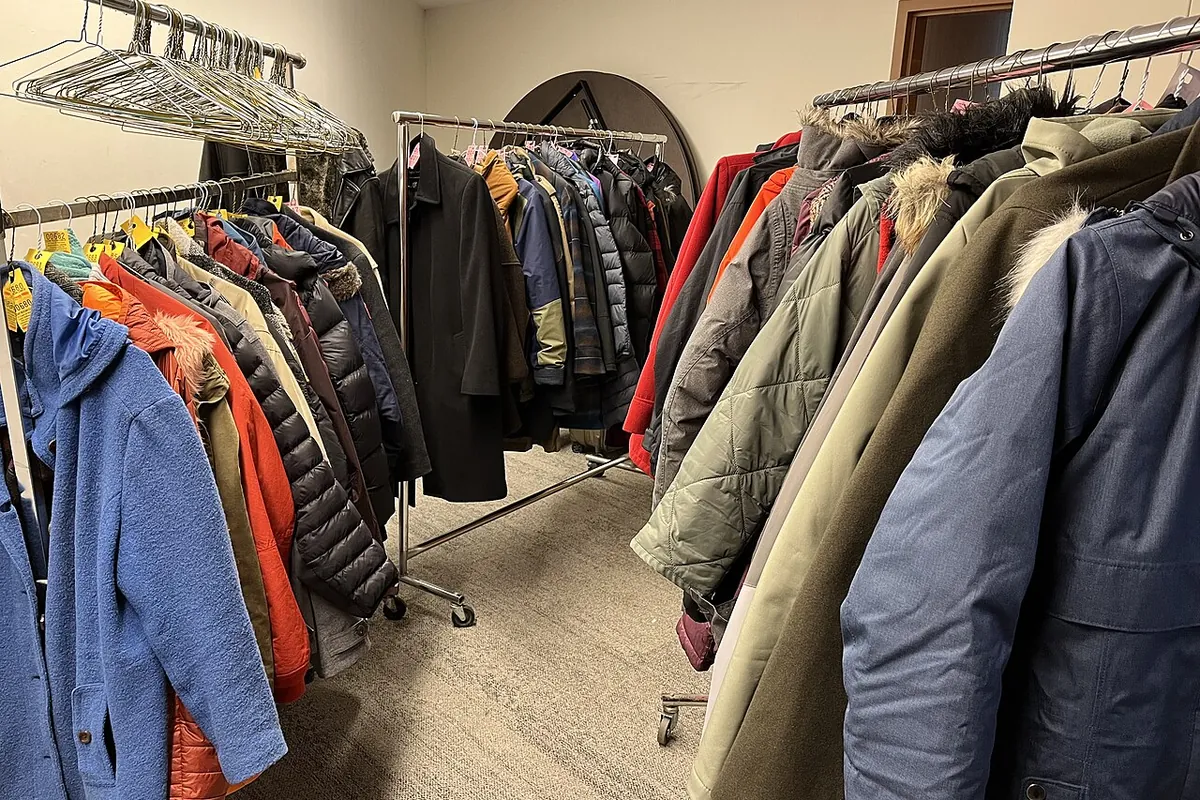
The coat rail is where a thrift shop earns its keep in November. A good winter coat is one of the most expensive things most people buy new, and one of the slowest to wear out, so the secondhand market is full of coats with years left in them. It is also full of coats that looked fine on the hanger and turned out to have a torn lining, a dead zip or a fill that had collapsed into lumps. A few minutes of looking closely makes the difference.
Decide what kind of warm you need
Winter coats keep you warm in different ways, and each has its strengths and its giveaways on the rack.
| Type | Good at | Weak at | Ages well if |
|---|---|---|---|
| Wool overcoat or peacoat | Dry cold, city wear, looking smart over anything | Heavy rain; can be heavy to carry | The cloth is dense and the lining is sound |
| Down jacket or parka | Very cold, dry days; light for its warmth; packs small | Gets wet and loses loft; sheds feathers when worn out | The fill is evenly spread and springs back |
| Synthetic-fill puffer | Damp cold; keeps some warmth when wet; easy to wash | Loses loft with age and compression | It has not been squashed flat for years |
| Waxed cotton or shell parka | Wind and rain; layers well over a fleece or sweater | Little warmth on its own | Seams, cuffs and zips are intact |
A wool coat over a good sweater is hard to beat for walking around town; for standing at a bus stop in a deep freeze or sitting around a winter campfire, down is warmer for its weight. If your winters are wet rather than bitter, a synthetic fill or a shell with layers underneath is often the better buy.
Fit: try it on over what you will wear
Bring, or wear, the thickest sweater you plan to put under the coat. A coat that fits over a T-shirt in a warm shop may not close over a knit in January.
- Shoulders first. The shoulder seam should sit at, or just past, the edge of your shoulder. Shoulders are the one thing a tailor cannot reasonably change on a coat, so a bad fit there is a reason to walk away.
- Reach forward and hug yourself. If the back pulls tight across the shoulder blades or the sleeves ride halfway up your forearms, it is too small.
- Sleeve length can often be shortened, less often lengthened. Look inside the cuff for spare fabric before counting on it.
- Do it up completely, every button or the zip from bottom to top, and sit down. A coat that strains at the buttons when you sit will tear at them in time.
Vintage and imported coats often run small for their labelled size. Ignore the number and trust the mirror, as with any vintage piece.
Checks for a wool coat
Start with the fibre label, which on wool garments sold in the U.S. is a legal statement of content; our guide to secondhand wool sweaters explains how to read it. A coat sold as wool that is mostly polyester or acrylic will pill faster and keep you less warm.
- Hold the cloth up to a light. Thin patches at the elbows, the seat and along the front edges show as brighter areas. So do the small holes of clothes moths, which go for wool, especially around the collar, under the arms and wherever the coat has been stained.
- Turn it inside out. Check the lining at the armholes, the hem and the inside pockets, where it tears first. A torn lining is a manageable repair and a good reason to ask for a lower price; a lining that is shredded everywhere means relining, which is a tailor's job.
- Look at the buttons and buttonholes. Loose buttons are easy to sew back; frayed or torn buttonholes are harder to make neat.
- Smell it. Mustiness usually comes out with airing and cleaning; heavy smoke or mildew in a thick wool coat can be stubborn.
Checks for a down or synthetic puffer
- Squeeze and let go. Good down springs back slowly and fully. Fill that stays flat, feels thin in places or has gathered into hard lumps at the bottom of each baffle has lost much of its warmth.
- Hold the jacket up to the window. In quilted down, light through some chambers and not others means the fill has shifted or leaked out.
- Look for escaping feathers. A stray feather is normal. Many quills poking through the seams or the shell fabric mean a worn shell that will keep shedding.
- Check the shell for tears and burns. Small holes from sparks or snags are common on jackets that have been near a campfire. They can be patched, but they let fill out until you do.
- Run every zip end to end, including pockets and the hood. A main zip that separates behind the slider or has missing teeth is the most common reason a good puffer ends up donated. It can be replaced, but it is fiddly and not cheap; factor it into the price.
What the care label does and does not tell you
In the U.S., the Federal Trade Commission's Care Labeling Rule requires most clothing to carry a permanent label with regular care instructions. One detail is useful to know: if a garment can safely be either washed or dry-cleaned, the maker only has to give one of the two methods (16 CFR § 423.6). "Dry clean" on a label therefore means dry-cleaning is safe, not necessarily that washing is forbidden; "Do not wash" is the instruction that rules washing out.
A missing or cut-out label is common on older coats. In that case, treat a wool coat as dry-clean only, and a down or synthetic jacket as a gentle, cool machine wash, until you know better.
Getting it ready to wear
- Air it outside on a dry day before anything else. Many smells fade without any cleaning at all.
- Brush a wool coat with a clothes brush, downwards, to lift dust and spot any moth larvae or eggs. If you suspect moths, a spell in a sealed bag in the freezer, or a professional clean, before it joins your other wool.
- Wash a down jacket on a gentle, cool cycle with a detergent meant for down, then tumble-dry on low with a few clean tennis or dryer balls to break up the clumps. It takes several cycles to dry right through; damp down left in the middle smells and clumps.
- Mend early. Restitch a loose button, close a lining tear and patch a small hole in a shell before the first proper outing; small repairs become big ones over a winter. Our guides to cleaning and mending secondhand clothes and to visible mending with patches and darns cover the basic stitches.
When to put it back
Walk away from a coat whose shoulders do not fit, whose cloth is worn thin across large areas, or whose down has gone flat everywhere; none of those can be fixed for a sensible price. Most other faults, a torn lining, a missing button, a stuck zip, a musty smell, are bargaining points rather than deal-breakers. Priced right, a coat with one of them is often the best buy on the rail.
Sources
- Federal Trade Commission, Care Labeling Rule, 16 CFR § 423.6, Textile wearing apparel (via Cornell's Legal Information Institute): what care labels must say, and when only one cleaning method needs to be given.
- University of California Statewide IPM Program, Pest Notes: Clothes Moths, for where moth damage tends to appear on wool garments.
 Thrift & vintage
Secondhand wool sweaters
Reading the fibre label, spotting moth damage and felting, and getting a good knit home safely.
 Thrift & vintage
Cleaning and mending thrift finds
Washing by fabric, smells, moths, buttons, seams and hems.
 Thrift & vintage
How to buy vintage clothes
Where to look, vintage sizing, what to inspect, label clues.