Macramé for beginners: cord, four knots and a first plant hanger
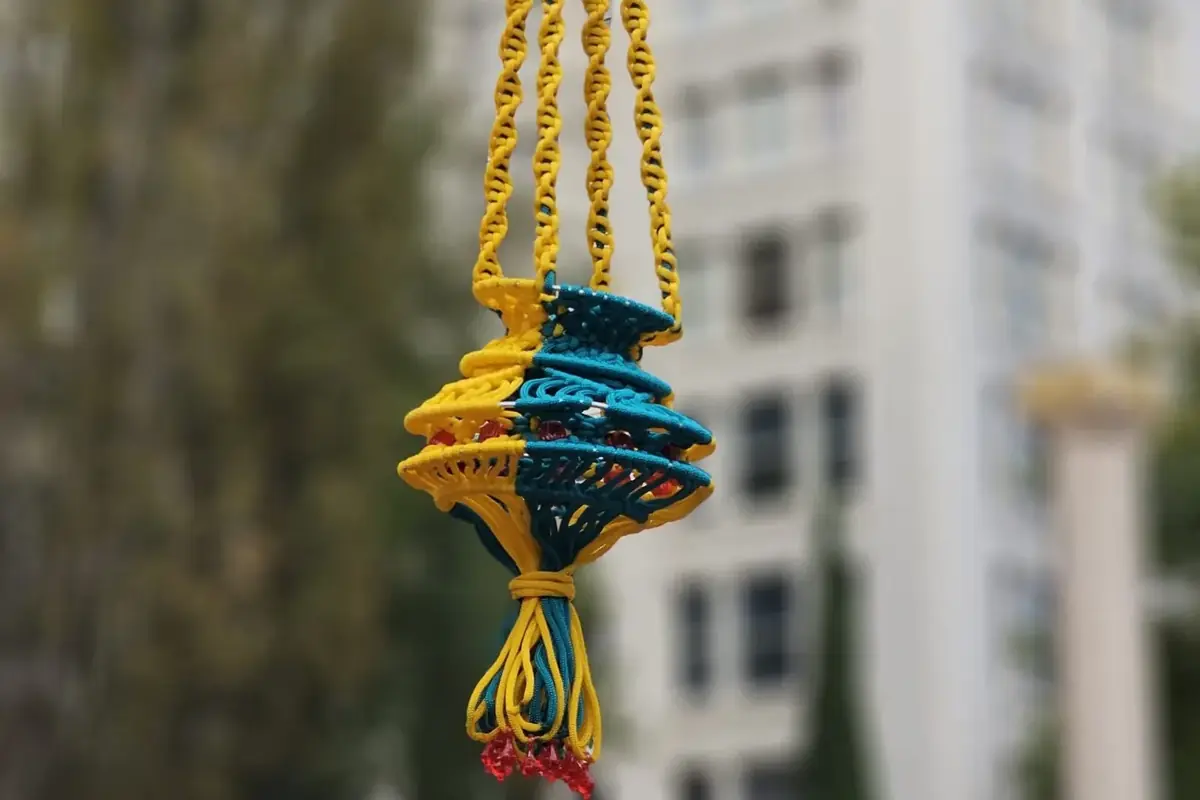
Macramé is knotting cord into patterns. It needs no machine, no pattern book and very little money, and the basic knots can be learned in an evening. Once you know four of them, you can make plant hangers, wall hangings, keyrings and bag straps.
Kit list
What you need
- Cord. Cotton cord is the easiest to learn with: soft on the hands, easy to untie when you make a mistake. For a first project, 4 to 5 mm cord is a comfortable size.
- Something to hang the work from: a wooden or metal ring for a plant hanger, a dowel or a straight stick for a wall hanging.
- Sharp scissors and a tape measure.
- A place to hang the work at a comfortable height while you knot: a clothes rail, a hook on the back of a door, or an S-hook on a curtain pole.
- Optional: masking tape to stop cord ends fraying, a comb to fluff out fringes.
Types of cord
| Cord | What it is like | Best for |
|---|---|---|
| Single-twist (single strand) cotton | Soft, combs out into a fluffy fringe | Wall hangings, fringes, feathers |
| 3-ply twisted cotton | Three strands twisted together; firm, defined knots | Plant hangers, beginner projects |
| Braided cotton | Very strong and neat; does not unravel or fringe well | Hangers carrying weight, straps |
| Jute, hemp | Rough, rustic, durable | Outdoor hangers, natural look |
| Synthetic (polypropylene, nylon) | Weather and water resistant | Outdoor items |
How much cord to cut
Knots use up a surprising amount of cord. A common starting rule is to cut each cord three to four times the finished length you want, and to remember that a cord folded in half through a ring or over a dowel gives you two working ends, so it must be double that again. Dense knotting uses more; long stretches of bare cord use less. When in doubt, cut longer: a short cord cannot be lengthened without a visible join.
The four basic knots
1. Lark's head knot (attaching cords)
This attaches a cord to a ring or dowel.
- Fold a cord in half to make a loop.
- Place the loop over the front of the dowel, then fold it down behind.
- Pull both cord ends through the loop and tighten.
Done the other way round (loop behind first), it becomes a reverse lark's head, which shows a horizontal bar on the front instead. Either is fine; just be consistent.
2. Square knot (the workhorse)
The square knot uses four cords: two outer "working" cords and two middle "filler" cords that stay still.
- Take the left cord and cross it over the two middle cords, making a shape like the number 4.
- Take the right cord, lay it over the tail of the left cord, pass it behind the middle cords and up through the loop on the left side. Pull both working cords to tighten. This is a half knot.
- Now mirror it: take the right cord over the middle cords, the left cord over its tail, behind the middle cords and up through the loop on the right. Tighten. Together the two halves make one square knot.
Spiral (half knot twist): if you repeat only the first half, again and again, the knots twist into a spiral, like the sections in the photo above. It is the quickest way to make an impressive-looking piece.
3. Double half hitch (lines and diagonals)
This makes a raised line across the work, horizontal or diagonal.
- Hold one cord (the "holding cord") across the other cords at the angle you want.
- Take the next cord, loop it up and around the holding cord, and pull it tight.
- Loop the same cord around the holding cord a second time, next to the first. That is one double half hitch.
- Repeat with each cord in turn along the holding cord.
Keep the holding cord taut and at a steady angle; that is what makes the line neat.
4. Gathering knot (wrap knot)
This binds a bundle of cords together, at the top or bottom of a plant hanger.
- Take a separate piece of cord. Make a long U-shaped loop and lay it against the bundle, with the loop pointing down and one short end sticking up above.
- Wrap the long end tightly around the bundle and the loop, working downwards, for as many turns as you like.
- Push the end of the wrapping cord through the loop at the bottom.
- Pull the short end at the top: the loop slides up under the wraps and locks the end in. Trim both ends close to the wraps.
First project: a simple plant hanger
This hanger holds a small or medium pot and uses only square knots and gathering knots. Choose a pot that is not too heavy once watered, and hang it from a hook that is screwed firmly into a joist or a sturdy bracket.
Kit list
You need
- One ring, 4 to 5 cm across (wood or metal)
- Eight cords of 3-ply cotton, about 3.5 metres each, for a hanger roughly 1 metre long
- Two short cords of about 1 metre for the gathering knots
Steps
- Attach the cords. Thread all eight cords through the ring and fold them so the ring sits at their midpoint. You now have sixteen hanging ends of equal length.
- Top gathering knot. Just below the ring, tie a gathering knot 3 to 5 cm long with one of the short cords. Hang the ring from a hook at about head height.
- Make four arms. Divide the sixteen ends into four groups of four.
- Knot the arms. About 10 to 15 cm below the gathering knot, tie a run of square knots on each arm: six to eight knots, or a spiral of half knots if you prefer. Start each arm at the same height so the hanger hangs level. Measure rather than guess.
- Leave a gap. Let 20 to 30 cm of bare cord hang below each knotted section. The pot's height decides this; hold the pot up to check.
- Make the net. Take two cords from one arm and two from the arm next to it, and tie one square knot with these four, about 8 to 10 cm below the end of the knotted sections. Go all the way round, so each new knot joins two neighbouring arms. You now have a zigzag "net".
- Second row (optional). Repeat one more row, about 6 to 8 cm lower, regrouping the cords back to the original arms. For a small pot, one row is enough.
- Bottom gathering knot. Bring all sixteen cords together about 6 to 10 cm below the last row and tie a gathering knot with the second short cord. Place the pot in the net before you tighten it, to check that the knots sit where the pot is widest.
- Finish the tail. Trim the ends to an even length, or a V shape. With 3-ply cord you can untwist the ends for a fluffy tassel and comb it out.
Common beginner problems
| Problem | Cause | Fix |
|---|---|---|
| Knots twist when they should lie flat | Repeating the same half knot instead of alternating sides | Start each square knot from the side that finished the last one |
| Arms of different lengths, pot tilts | Knotting by eye | Measure from the top gathering knot, and mark heights with tape |
| Ran out of cord | Dense knotting uses more than expected | Cut longer next time; plan bare sections to save cord |
| Uneven tension, lumpy rows | Pulling some knots harder than others | Tighten each knot with the same pull; practise on a scrap |
Where to go next
- A small wall hanging: attach cords to a dowel with lark's head knots, then make a few rows of alternating square knots and a diagonal line of double half hitches. Finish with a long combed fringe.
- Keyrings and bag charms: a dozen square knots on four short cords around a split ring.
- Beads: slide wooden beads onto the filler cords between knots. Check that the hole is large enough for the cord before buying.
Cotton cord, rings and dowels also turn up in thrift stores and craft swap shops, often for very little. A macramé hanger with a trailing plant is one of the cheapest ways to bring life into a room; the small-budget bedroom guide has more ideas like it.
Care
Dust cotton macramé with a soft brush or a hairdryer on cool. If a plant hanger gets wet regularly, let it dry fully to avoid mildew, and check knots and cord for wear once in a while, since cotton weakens with sun and damp over time. For outdoor use, synthetic cord lasts longer.
 Home & handmade
A calm bedroom on a small budget
Edit, set a colour plan, layer textiles and shop secondhand.
 Camp & seasonal kitchen
Growing mint all season
Pots, not beds; cutting back; and using a big harvest.
 Home & handmade
Southwestern-style rugs and kilims
Reading a rug's construction, 'Indian-made' rules, and care.