Henry David Thoreau: his life in Concord, two years at Walden Pond, and what he actually wrote

This site borrows its name from Henry David Thoreau, so it seems only fair to tell his story properly. He is quoted everywhere, often with words he never wrote, and remembered as a hermit, which he was not. The real man was a pencil maker, surveyor, lecturer and tireless walker from a small Massachusetts town, who spent two years and two months in a one-room house he built himself beside a pond, and then wrote a book about it that people are still arguing over. Here is what the record says, with his own lines quoted exactly from his published pages.
A Concord life, 1817 to 1862
Thoreau was born on 12 July 1817 in Concord, Massachusetts, as David Henry Thoreau; he later reversed his first names. He studied at Harvard College from 1833 to 1837, came home, taught school for a while, and worked on and off in his family's pencil business for most of his adult life, alongside surveying, lecturing and writing. These dates and details are set out in the well-sourced Wikipedia biography, which also notes the size of the journal he kept for 24 years: some two million words.
Concord in the 1840s was a lively place for a young writer. Ralph Waldo Emerson lived there, and it was on a woodlot Emerson had bought on the shore of Walden Pond, about a mile and a half from the Thoreau family home, that the famous experiment took place.
Two years and two months at Walden Pond
Thoreau tells the beginning himself: "Near the end of March, 1845, I borrowed an axe and went down to the woods by Walden Pond, nearest to where I intended to build my house, and began to cut down some tall arrowy white pines, still in their youth, for timber." He started sleeping there, he writes, "by accident" on Independence Day, the Fourth of July 1845, before the house was finished for winter.
The house itself is described with a surveyor's precision: "ten feet wide by fifteen long, and eight-feet posts, with a garret and a closet, a large window on each side, two trap doors, one door at the end, and a brick fireplace opposite." He even printed the bill for materials, down to second-hand windows and a thousand old bricks, for a total of $28.12½, explaining that he gave the details "because very few are able to tell exactly what their houses cost". Anyone who has priced a first flat will appreciate the gesture; we touch on that in our guide to a first home on a small budget.
He was never cut off from the world. The town was a short walk away, friends and curious neighbours came by, and he kept, in his own words, "three chairs in my house: one for solitude, two for friendship, three for society." He grew beans, wrote, read, and walked. He left on 6 September 1847. The opening page of the book sums up the arrangement: "I lived there two years and two months. At present I am a sojourner in civilized life again."
The night in jail
In July 1846, while living at the pond, Thoreau was arrested in Concord for refusing to pay several years of poll tax. He gave his opposition to slavery and to the Mexican–American War as his reasons, and spent one night in the town jail before someone, probably his aunt, paid the tax against his wishes. He turned the episode into a lecture and then an essay, "Resistance to Civil Government", published in May 1849 and now usually known as "Civil Disobedience". It has been read and cited by very different movements since.
The book: Walden, 1854
He did not publish quickly. His first book, A Week on the Concord and Merrimack Rivers, drafted at the pond, sold poorly. Walden; or, Life in the Woods came out in 1854, seven years after he left the cabin, reworked through many drafts. It is not a survival manual. It is a long, funny, cranky and often beautiful argument about what a life needs and what it can do without. Its best-known lines are worth reading in their own context rather than on a poster:
- "The mass of men lead lives of quiet desperation." (from the first chapter, "Economy")
- "I went to the woods because I wished to live deliberately, to front only the essential facts of life, and see if I could not learn what it had to teach, and not, when I came to die, discover that I had not lived." (from "Where I Lived, and What I Lived For")
- "Simplicity, simplicity, simplicity! I say, let your affairs be as two or three, and not a hundred or a thousand". (same chapter)
- "If a man does not keep pace with his companions, perhaps it is because he hears a different drummer." (from the "Conclusion")
- "I left the woods for as good a reason as I went there. Perhaps it seemed to me that I had several more lives to live, and could not spare any more time for that one." (from the "Conclusion")
Those quotations are checked against a scanned edition of Walden at the Internet Archive; the 1854 text is also transcribed on Wikisource. The book is in the public domain, so there is no excuse for misquoting it. A good rule of thumb: if a "Thoreau quote" sounds like a greeting card and comes without a chapter, be suspicious.
A walker, in every season
Much of Walden is simply close attention to a place. Thoreau sounded the pond through the ice with "a cod-line and a stone weighing about a pound and a half" and found that "the greatest depth was exactly one hundred and two feet". In winter, he writes, "I frequently tramped eight or ten miles through the deepest snow to keep an appointment with a beech tree, or a yellow-birch, or an old acquaintance among the pines". Later essays and books, published after his death, such as The Maine Woods and Cape Cod, come from longer trips.
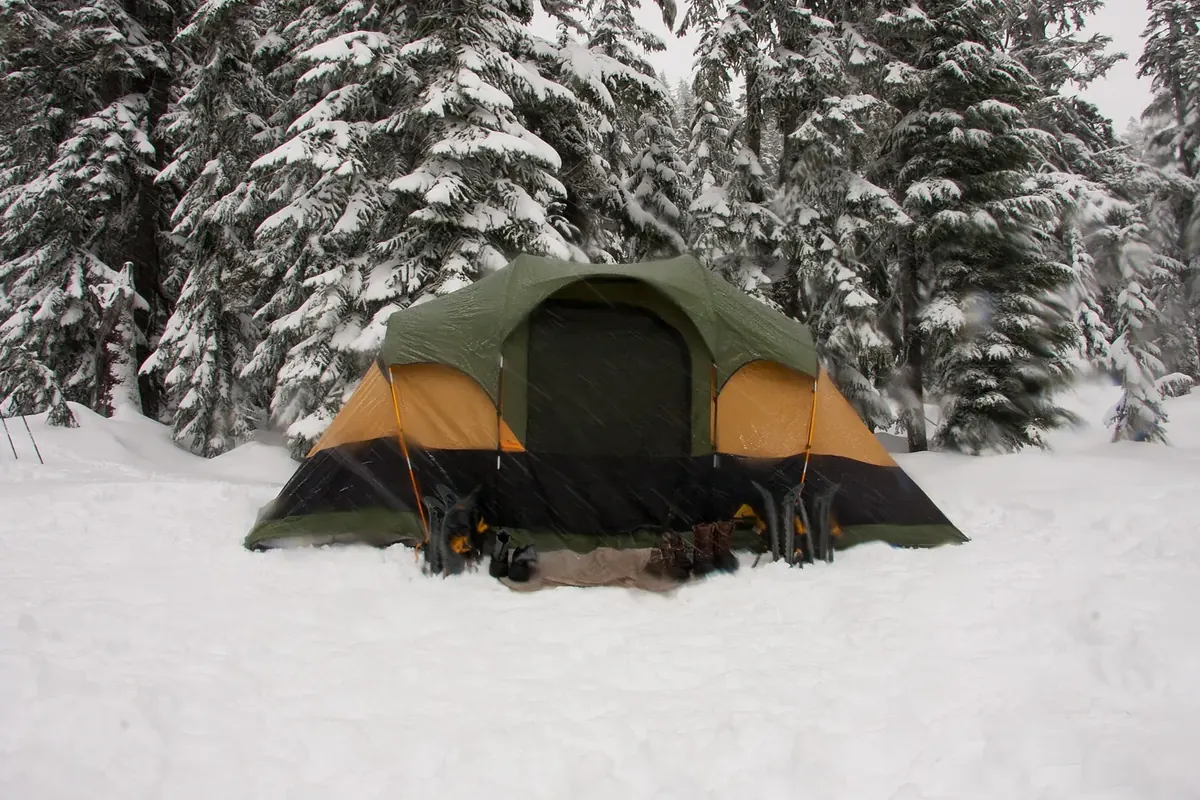
If that kind of walking appeals, start small and prepared. Our first day hike guide covers the Ten Essentials, and for winter outings, staying warm on a cold night in a tent is the practical companion to Thoreau's snowy appointments.
His death and his legacy
Thoreau died of tuberculosis in Concord on 6 May 1862, aged 44, and is buried in Concord's Sleepy Hollow Cemetery. His reputation grew slowly and then enormously. The Thoreau Society, founded in 1941 and based in Concord, describes itself as "the oldest and largest organization devoted to an American author". In March 2026, PBS aired a three-part, three-hour documentary, Henry David Thoreau, directed by Erik and Christopher Loren Ewers with Ken Burns and Don Henley as executive producers; the PBS announcement gives the details, and WBUR looked at what the film says about his legacy beyond the cabin.
That legacy is easy to see today in the appetite for simple living, long walks and time outdoors with family, including in very modern forms: our piece on the Outdoor Boys YouTube channel looks at one of the most popular. And the question at the heart of Walden, town or country, is still with us; we looked at what the data say about city and country living today.
Visiting Walden Pond and Concord today
Walden Pond is a glacial kettle hole, formed as the ice retreated some 10,000 to 12,000 years ago. The land was given to the Commonwealth of Massachusetts in 1922, the pond was designated a National Historic Landmark in 1962, and it is now managed as the Walden Pond State Reservation by the state's Department of Conservation and Recreation (the Walden Pond article summarises this history). A few things to know before you go:
- The cabin site is a short walk north of the pond, marked by granite posts. A replica of the house stands near the visitor centre and main car park, where you can see just how small ten feet by fifteen really is.
- It is a day-use park: no overnight camping. In summer it is a popular swimming spot and the reservation closes to new arrivals when it reaches capacity, so go early or out of season.
- No dogs or other pets are allowed at any time of year, and parking is paid. Check the state park page for current hours and fees before you travel, as they change.
- Walden Woods, the forest around the pond, has been partly protected since 1990 by the Walden Woods Project, founded by Don Henley; its library in nearby Lincoln holds a large Thoreau collection, and its Thoreau pages are a reliable place to check a quotation.
- In Concord itself, Thoreau's grave is on Author's Ridge in Sleepy Hollow Cemetery, near those of Emerson, the Alcotts and Hawthorne.
Leave no trace, keep to the marked paths around the shore, and bring your own copy of the book. Reading "The Pond in Winter" on a cold bench above the water is a very good way to spend an hour.
 Trails & campsites
Outdoor Boys, the facts
Who makes the channel, how it grew, why it stopped in 2025, and which skills to learn properly before trying a snow shelter of your own.
 Home & handmade
City or country, in figures
A quarter of Europeans live in rural areas, four in five Americans in urban ones, and the countryside has more room per person: the figures, dated and sourced.
Trails & campsitesYour first day hike
A trail you can finish, the Ten Essentials, weather and daylight, and how to leave the trail as you found it.